Scaling engineering teams loses time in ways roadmaps rarely capture. A build breaks for a mysterious reason. A deploy needs one small permission. A new service takes days just to wire up pipelines, secrets, and logging.
You see it in the cracks. One team has a smooth delivery flow, another runs a different setup, and someone is still copy-pasting YAML from an old repo and hoping it holds. Everyone is doing DevOps, but the day-to-day experience is inconsistent.
That’s where platform development comes in. It’s about building shared foundations and self-service golden paths so teams can ship faster, safer, and with less repeated effort. Let’s break it down.
What is a Platform in Software Development?
A platform is a reusable foundation that enables other software to be built, run, and operated consistently.
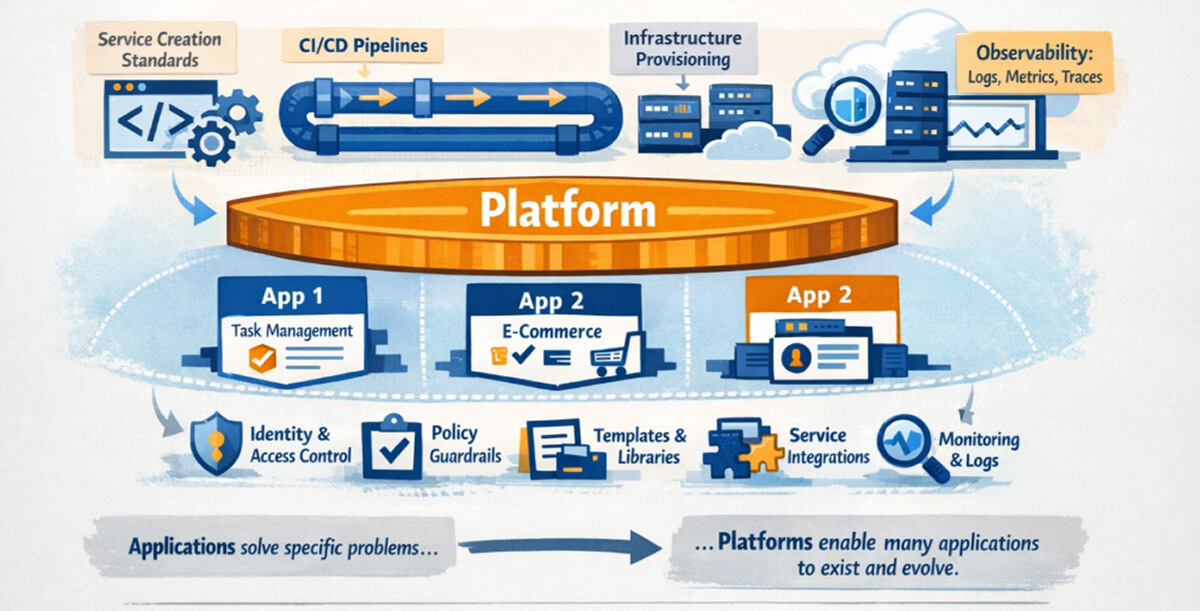
In software development, platforms usually provide things like:
- Standard ways to create services.
- CI/CD pipelines and deployment workflows.
- Infrastructure provisioning patterns.
- Observability defaults (logs, metrics, traces).
- Identity, access control, and policy guardrails.
- Templates, libraries, and service-to-service integrations.
A useful mental model is: applications solve a specific problem; platforms enable many applications to exist and evolve.
Atlassian frames platform engineering as building toolchains and workflows that provide self-service capabilities so teams can build and ship without constantly waiting on another team.
Software Platform vs. Application: What’s the Difference?
This phrase is searched for a lot: software platform vs. application. And the confusion is fair, because some products are both.
Application
An application is typically built to serve end users or a business workflow. It has a defined purpose, such as:
- A billing system.
- A mobile banking app.
- A customer support portal.
Platform
A platform is designed to support multiple applications, teams, or integrations. Its purpose is to enable:
- Faster delivery.
- Consistency.
- Scalability.
- Reuse.
OutSystems explains this distinction clearly, emphasizing that platforms provide the base environment and capabilities on which applications are built.
A simple question to ask is:
If we removed this system, would one product stop working, or would many teams lose the ability to build and ship effectively?
If it’s the second one, you are probably dealing with a platform.
Platform Development vs. “Just Building Infrastructure”
Here’s a common mistake: treating platform development like a one-time infrastructure project.
Infrastructure matters, but platform development is also a product problem.
The GetDX perspective is helpful here: platform development succeeds when it reduces developer friction, not just when it deploys reliable infrastructure. A platform can be stable yet painful to use.
So a strong platform team thinks like a product team:
- Who are our users (backend devs, frontend devs, data teams)?
- What are their most frequent pain points?
- What is the “default path” we want them to take?
- Are we saving them time, or just adding another system?
Types of Software Development Platforms
When people say “software development platforms,” they might mean different things. These often overlap, but it helps to separate them:
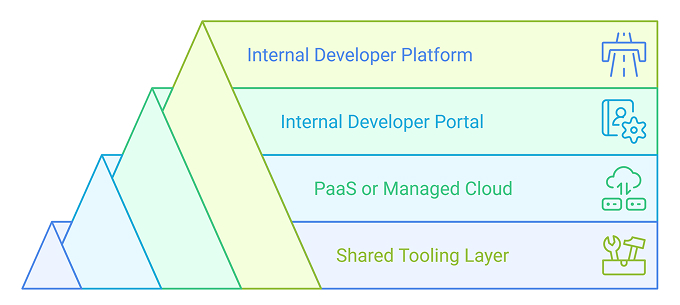
1. Internal Developer Platform (IDP)
An internal developer platform provides standardized paths from code to production, often including templates, pipelines, environments, and operational tooling. Microsoft’s “paved road” idea fits here.
Also note the naming confusion: CNCF has discussed how “IDP” sometimes gets used to mean portal rather than platform, even though a portal is typically just one interface into the broader platform.
2. Internal Developer Portal
This is often the UI layer, containing service catalog, docs, ownership, templates, links, and workflows. A portal can be part of an IDP, but it’s not the whole thing.
3. PaaS or Managed Cloud Platforms
These are platforms offered by cloud providers or vendors. They provide runtime, deployment, and managed services. They reduce operational load, but you still may need internal platform work to standardize usage across teams.
4. Shared Tooling and Enablement Layer
Sometimes the platform is a curated set of tools (e.g., CI/CD, IaC modules, secrets, observability) plus well-supported patterns.
What Great Platform Development Looks Like
A healthy platform is boring in the best way. It is predictable.
Here are signals you are doing it right:
- Self-service is real: Teams can provision what they need for basic tasks without tickets.
- Golden paths exist: Not forced, but clearly the easiest way to do the right thing.
- Guardrails are baked in: Security and compliance are defaults, not afterthoughts.
- Adoption happens naturally: Teams use it because it saves time, not because leadership mandates it.
And yes, you still measure reliability, but you also measure developer experience. GetDX highlights that uptime alone doesn’t prove usefulness.
How to Start Platform Development Without Creating a “Platform Tax”
Platform work can backfire if it adds steps and approvals. Start small and earn trust.
Step 1: Pick one narrow golden path
Example targets include:
- New service scaffold, CI pipeline, and deploy to dev.
- Standard logging, metrics, and alerts for all services.
- One-click ephemeral preview environments.
Step 2: Make the default path easier than the DIY path
If using the platform requires extra docs, extra permissions, and extra meetings, teams will route around it.
Step 3: Invest in documentation and ownership
A platform without clear docs becomes tribal knowledge. A platform without ownership becomes that thing nobody wants to touch.
Step 4: Create feedback loops
Treat platform users like customers by providing:
- Short surveys after onboarding.
- Office hours.
- A Slack channel with fast response times.
- “Top friction points” review every month.
GitHub’s overview of platform engineering emphasizes standardization and workflow enablement as core goals, which aligns with this incremental approach.
Platform Development is a Force Multiplier
The biggest payoff of platform development is not a single feature. It is compounding consistency.
When you build a platform that teams trust, good practices spread faster:
- Safer releases become the norm.
- Observability is built in from day one.
- Security controls stop feeling like “extra work.”
- Teams spend more time on product value and less on plumbing.
So the next time someone says, “We should build a platform,” the better question is:
What is the one developer workflow we can make dramatically easier this quarter?
Because that is how real platforms grow. One paved road at a time.
Conclusion
Platform development is basically the work of turning “tribal knowledge” into a reliable, repeatable system. Instead of every team reinventing CI/CD, environments, observability, and security patterns, a platform gives them a paved road to production. The best platforms do not feel like a gate. They feel like a shortcut, resulting in fewer decisions, fewer tickets, and fewer surprises.
If you take one thing from this, make it this: platform development succeeds when it removes friction for developers while raising the baseline for quality. Start with one golden path, make it genuinely easier than the DIY route, and keep improving it based on real usage. Over time, that consistency compounds and the entire engineering org ships faster and safer, without burning people out.